
Mold
Mold in air ducts: how to tell, and what to do first
Mold in air ducts is one of the three situations in which EPA says duct cleaning is worth considering, but only when it is real mold, it is substantial, and the moisture that fed it has been found. Cleaning it without fixing the leak, condensation or blocked drain behind it only buys a few months.
Is it mold or just dust?
Most dark marks around a supply register are not mold. Air leaving a register is cooler or warmer than the room, and fine dust from the room sticks to the ceiling or the register edge in a grey or black fan shape. That is soiling, and it wipes off. Mold usually looks different, and the difference matters because only mold changes what you should do.
| Sign | More likely dust or soot | More likely mold |
|---|---|---|
| Look | Even grey film, a fan shape on the ceiling around the register | Spots or fuzzy patches, often in clusters, black, green, white or brown |
| Where | On the register face and the ceiling next to it | Inside the duct, on the coil, in the drain pan, on damp insulation |
| Smell | Dusty or none | Musty, earthy, strongest when the system starts |
| After wiping | Comes off and stays off for months | Leaves a stain or returns within weeks |
| Nearby moisture | None | Sweating ducts, a wet drain pan, a past leak, high indoor humidity |
EPA notes that you often cannot tell mold by looking: many substances look like it, and a laboratory analysis of a sample is the way to be sure. If a company tells you that you have mold, ask to see where, ask for a photo, and ask whether a sample was tested.
Why mold grows in an HVAC system
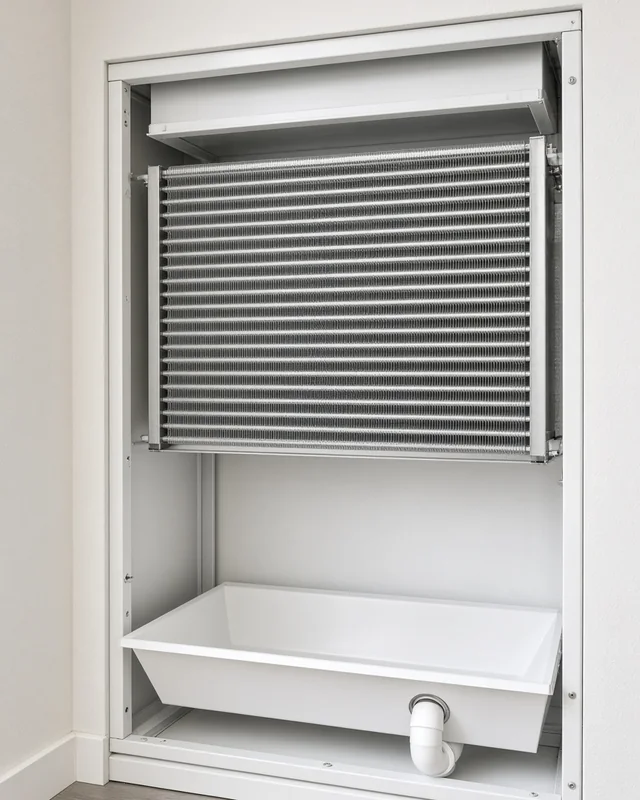
Mold needs moisture, and an air conditioning system makes plenty of it. The coil pulls water out of the air all summer; that water runs into a drain pan and out through a drain line. When the line clogs, the pan overflows or holds standing water. Ducts that run through a hot attic or a damp crawlspace can sweat on the outside, or on the inside when cold supply air meets warm, humid air through a leak. An oversized system that runs short cycles may never dry the air properly. Any of these keeps a surface damp long enough for spores, which are in every house, to grow.
So the first question about mold in ducts is never "who can clean it?" It is "where is the water coming from?" Common answers are a blocked condensate drain, a rusted pan, uninsulated supply ducts in an attic, leaky duct joints pulling in humid air, or an old roof or plumbing leak above the duct.
The order of the work
- Find and fix the moisture. Clear or repair the drain line and pan, insulate or seal sweating ducts, fix leaks, bring humidity down.
- Confirm the mold and its extent. Visual inspection of the ducts, coil, pan and air handler, and a sample if there is doubt.
- Remove or replace. Clean mold from hard surfaces such as sheet metal; replace wet or moldy fiberglass lining, duct board and flex duct.
- Clean the rest of the system. Mold spores and debris spread through the system, so the coil, blower and ducts downstream are cleaned too.
- Check that it stays dry. Look again after a few weeks of cooling season, especially at the drain pan.
Which ducts can be cleaned of mold
Bare sheet metal can be cleaned: the mold sits on a hard, non-porous surface and can be scrubbed and vacuumed off. Porous materials are another matter. EPA's guide says that if ducts are made of fiberglass duct board or insulated inside with fiberglass, and they are wet or moldy, they cannot be effectively cleaned and should be removed and replaced. Flexible duct with a plastic liner and insulation jacket is usually replaced too when mold or pests have been inside it, because it is inexpensive compared with the effort of cleaning it and the result is certain.
Sprays, foggers and coatings
Many mold offers include spraying an antimicrobial into the ducts. Read our page on air duct sanitizing before you agree to one. Two facts from EPA matter here: no chemical biocide is registered by EPA for use inside internally insulated ducts, and any product used should be registered for that use and applied only after the ducts have been cleaned. A spray is not a substitute for removing mold, and it does nothing about the moisture.
Rules in Texas and California
Texas licenses mold work. The Texas Department of Licensing and Regulation (TDLR) runs the state's mold assessment and remediation program, with a specific rule on mold remediation in HVAC systems (16 Tex. Admin. Code § 78.130). Separately, TDLR's air conditioning rules let an unlicensed company clean ducts only within narrow limits, from the supply plenum to the grilles and from the return grille to the air handler, with no cuts, no electrical changes and no disassembly beyond the grilles (§ 75.100(c)). Antimicrobials in Texas ducts call for an air conditioning and refrigeration (ACR) license. In Dallas–Fort Worth, ask for the TDLR license numbers and look them up before the work starts.
California has no separate mold license. Work that goes beyond cleaning, such as replacing ducts or repairing the system, is contractor work; check the company on the Contractors State License Board's site before you sign.
Mold in air ducts
Found what looks like mold in the ducts?
Tell us what you are seeing. We call or email you back to talk it through and, when the work makes sense, pass your request to a company that does it; it costs nothing.
Tell us about the mold you found
Tell us what you are seeing (dust, a smell, a slow dryer, a past leak or pests) and your city or ZIP. We call or email you back to talk it through and, if the work makes sense, to pass your request to a company that does it; sending this costs nothing.
Mold in air duct questions
Can mold in air ducts make you sick?
EPA says spores from mold growth in a system can be released into the living space, and some people may have allergic reactions or other symptoms if exposed. It does not say how much is harmful. If someone in the house has symptoms, talk to a doctor, and treat visible mold in the system as a reason to act.
How do I know for sure that it is mold?
By testing. EPA notes that many substances look like mold, so a sample analysed by a laboratory is the way to be certain. A trustworthy cleaner shows you where the growth is and offers a sample when there is doubt, rather than calling every dark mark mold.
Do moldy flex ducts have to be replaced?
Usually, yes. Flex duct is a thin plastic liner inside a wrap of insulation, which is hard to clean without tearing, and EPA says wet or moldy fiberglass-insulated ducts cannot be effectively cleaned. Replacing the affected runs removes the mold for certain, once the moisture source is fixed.
Sources: U.S. EPA, Should You Have the Air Ducts in Your Home Cleaned? (EPA-402-K-97-002); 16 Tex. Admin. Code § 78.130 and § 75.100; TDLR, License search; CSLB, Check A License.