
Leaks
Duct sealing: why leaks matter more than dust
Duct sealing closes the gaps, holes and loose joints in the ducts that carry heated and cooled air. According to ENERGY STAR, in a typical house about 20 to 30 percent of the air moving through the duct system is lost to leaks, holes and poorly connected ducts. Cleaning does nothing about it; sealing does.
Signs your ducts are leaking
Leaks are rarely visible from the living space, but they leave clues. Several of these together make leakage likely.
- Rooms that never reach the set temperature, especially those at the end of long duct runs.
- Weak air flow from some registers while the system is clearly running.
- High heating or cooling bills compared with similar homes.
- Dust, insulation fibers or a crawlspace smell coming from registers, which can mean a leaky return duct is drawing air from unconditioned space.
- Ducts in the attic or crawlspace that are crushed, disconnected, kinked or held together with cloth duct tape that has dried and peeled.
- A stuffy, humid feeling in summer, when leaky returns pull hot, damp attic air into the system.
Why the return side matters
Supply leaks waste energy: cooled or heated air escapes before it reaches the room. Return leaks do something worse for the air inside. A return duct is under suction, so any gap draws air from wherever the duct runs: attic insulation, a dusty crawlspace, the inside of a wall, sometimes a garage. That air bypasses the room it should come from, and whatever it carries goes into the system. Some homes that "need duct cleaning every year" actually have a leaking return that refills the ducts with dust. Sealing it solves both problems.
How ducts are sealed
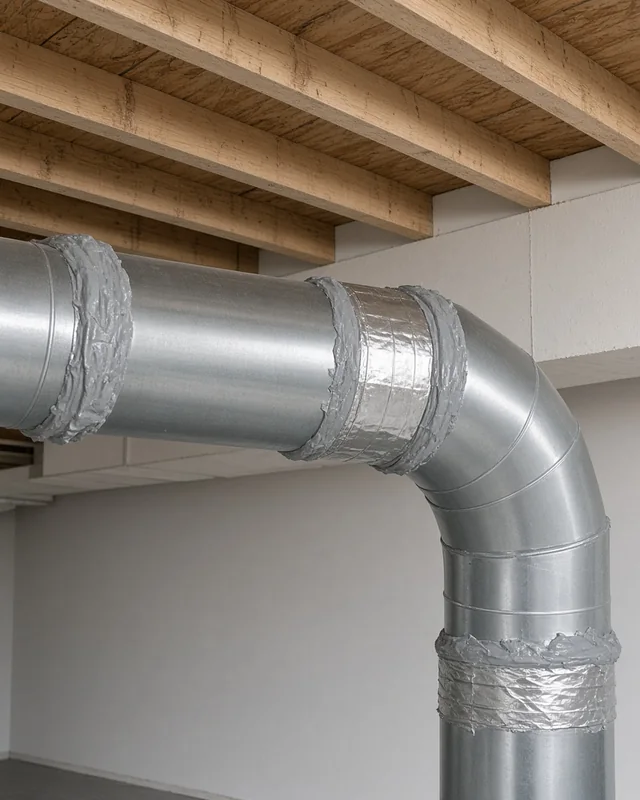
ENERGY STAR's advice is simple: seal leaks with mastic sealant or metal tape, and insulate the ducts you can reach. It also warns never to use ordinary cloth duct tape, because it is not long-lasting; heat in an attic dries its adhesive and it falls away within a few years.
- Find the leaks. A visual check of accessible ducts finds the obvious gaps; a duct leakage test with a calibrated fan measures how much the system leaks overall.
- Reconnect and support. Loose or fallen runs are reattached and hung properly, and crushed flex duct is straightened or replaced. When most of the system is failing, read about duct replacement instead.
- Seal the joints. Mastic, a thick paste brushed over seams and connections, or foil-backed metal tape rated for ducts, closes each joint, including where ducts meet the registers and the air handler.
- Insulate. Ducts in unconditioned spaces are wrapped so they neither lose heat nor sweat in summer.
- Test again. A second leakage test shows how much was gained.
A newer method seals ducts from the inside: the registers are blocked, the system is pressurized, and a fine aerosol sealant is blown in so particles collect at the gaps and close them. It reaches leaks inside walls and ceilings that cannot be reached by hand. Ask what it seals, how leakage is measured before and after, and what the product is.
Sealing and cleaning in the same visit
If your ducts genuinely need cleaning, for one of EPA's reasons such as mold, vermin or heavy debris, clean first and seal afterward, so dirt is not sealed in. When the access holes cut for cleaning are closed, they should be patched with sheet metal and sealed with mastic or metal tape, not left with a cap and cloth tape. If your ducts only need sealing, there is no reason to pay for a cleaning to go with it.
Rules that can apply in California and Texas
In California, the state energy code, Title 24, sets duct leakage requirements, and replacing or altering an HVAC system or its ducts can trigger a duct leakage test checked by a third-party HERS rater. Ask your installer and your city's building department what applies to your project before work starts. In Texas, sealing and repairing ducts goes beyond the narrow duct-cleaning exemption in 16 Tex. Admin. Code § 75.100(c), which forbids cuts to ducts, so it is air conditioning work: ask for the company's TDLR air conditioning and refrigeration license number.
Duct sealing
Rooms that never get warm or cool enough?
Tell us what you are seeing. We call or email you back to talk it through and, when the work makes sense, pass your request to a company that does it; it costs nothing.
Ask whether your ducts are leaking
Tell us what you are seeing (dust, a smell, a slow dryer, a past leak or pests) and your city or ZIP. We call or email you back to talk it through and, if the work makes sense, to pass your request to a company that does it; sending this costs nothing.
Not every dark mark at a register means leaky or dirty ducts. Our guide to black dust around vents explains how to tell room dust from soot, and the furnace sign to act on.
Duct sealing questions
How much air do leaky ducts lose?
ENERGY STAR says that in a typical house about 20 to 30 percent of the air moving through the duct system is lost to leaks, holes and poorly connected ducts. Homes with ducts in an attic or crawlspace lose that air outside the living space entirely, which is why sealing those runs pays off most.
Can I seal my own ducts?
You can seal the joints you can reach, in a basement, attic or crawlspace, with mastic or foil metal tape made for ducts, never cloth duct tape. Leaks inside walls, and anything involving cutting or rebuilding ducts, are a job for an HVAC contractor, who can also measure leakage before and after.
Is duct sealing the same as duct cleaning?
No. Cleaning removes dust and debris from inside the ducts; sealing closes the gaps in them. They solve different problems. Sealing a leaky return can reduce how much dust gets into the system in the first place, but it removes none of what is already there.
Sources: ENERGY STAR, Duct Sealing; California Energy Commission, Building Energy Efficiency Standards (Title 24, Part 6); 16 Tex. Admin. Code § 75.100; TDLR, License search.