Air Duct Repair and Duct Sealing
Duct repair and duct sealing are the mechanical corrections that restore a forced-air system’s integrity: reconnecting separated runs, replacing failed joint tape with fastened and mastic-sealed connections, correcting crushed flexible duct, and closing gaps at plenums, takeoffs and boots. It is a different job from duct cleaning, and the one that addresses leakage: cleaning does not close a gap in a duct wall.
What duct leakage actually is
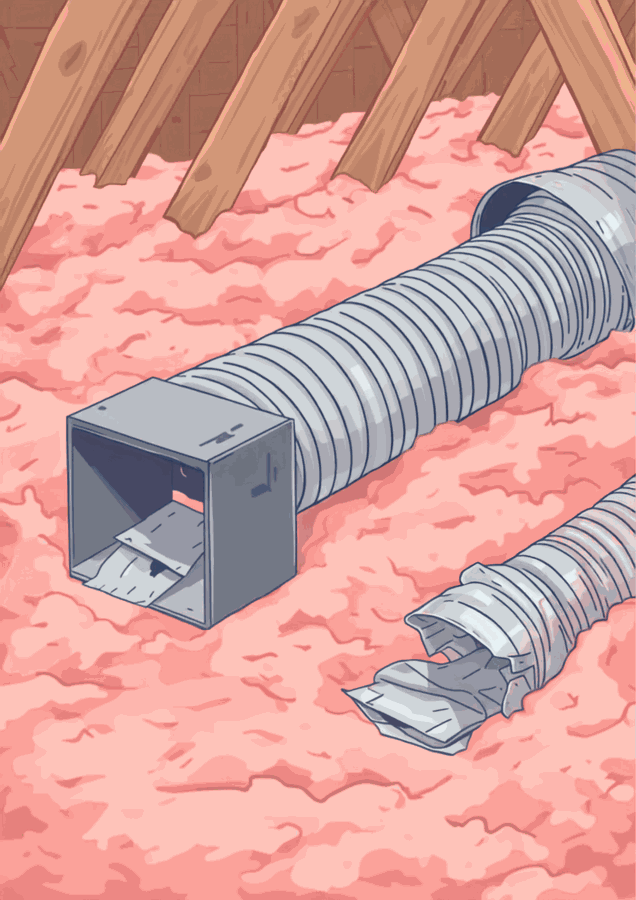
Leakage is air moving into or out of the ducts anywhere other than a register or grille. On the supply side, conditioned air escapes into an attic, crawl space or chase. On the return side the pressure reverses and the system draws air in from those cavities. Some zones starve while others overshoot.
Leakage also moves moisture, so it is not only an energy question. EPA states that moisture can enter the duct system through leaks or if the system has been improperly installed or serviced, and that condensation or high relative humidity is an important indicator of the potential for mold growth on any type of duct.
Where ducts typically fail
Separated and disconnected runs
The most consequential defect is the simplest: a run that has come off its collar, usually flexible duct held by tape and friction rather than fastened. A disconnected supply delivers its full airflow into an unconditioned cavity.
Failed tape at joints, plenums and boots
Cloth-backed duct tape fails predictably: the adhesive dries, the carrier shrinks, the joint opens. Plenum seams, takeoff collars, branch connections and register boots are the recurring locations. Boots are often the largest single leak path, because the connection to the building assembly was never sealed.
Crushed and compressed flexible duct
EPA notes that since the early 1970’s, a significant increase in the use of flexible duct has occurred. Flex damages easily: pinched over framing, crushed under stored material, or left sagging so the liner corrugates.
Cleaning is not repair
Duct cleaning, as EPA describes it, covers system components: ducts, registers, grilles and diffusers, coils, drain pans, and the fan and air handler housings. See what air duct cleaning actually covers and HVAC duct cleaning at the system level.
What cleaning does not do is change the pressure boundary. EPA is direct: little evidence exists that cleaning only the ducts will improve the efficiency of the system. On energy, EPA is equally direct: use of sealants to encapsulate the inside surfaces of ducts is a different practice than sealing duct air leaks, and sealing duct air leaks can help save energy on heating and cooling bills. We describe the mechanism; we do not guarantee a result.
How sealing is done
A durable seal is mechanical first and adhesive second. Connections are physically fastened with screws, straps or draw bands at the collar, so the joint cannot separate. Mastic or a foil-backed tape rated for the application then closes the remaining path at clean, dry joints.
Two limits are firm. EPA is explicit that sealants should never be used on wet duct liner, to cover actively growing mold, or to cover debris in the ducts. EPA reports that it, NADCA, NAIMA and SMACNA do not currently recommend the routine use of sealants. That is not our method; closing leaks at joints is.
When repair should precede cleaning
EPA’s sequencing rule reads: prior to any cleaning, retrofitting, or replacing of your ducts, the cause or causes must be corrected or else the problem will likely recur. A return leak pulling dust from a crawl space should be corrected before cleaning is priced.
EPA states that controlling moisture is the most effective way to prevent biological growth in air ducts, that mold growth recurs if its cause is not corrected, and that where insulated duct insulation gets wet or moldy it cannot be effectively cleaned and should be removed and replaced. Surface work belongs with our nationwide duct cleaning service.
What we will not claim
We do not promise a health outcome. EPA’s position is that duct cleaning has never been shown to actually prevent health problems, and EPA advises consumers not to hire duct cleaners who make sweeping claims about the health benefits of duct cleaning. EPA neither certifies nor endorses duct cleaning companies. Suspected asbestos stops the job: asbestos-containing materials require specialized procedures and should not be disturbed or removed except by specially trained and equipped contractors. For larger sites see commercial air duct cleaning.
Get the system assessed
A repair and sealing scope must be written from what is found: which connections are open, which sections are restricted, and what is reachable. EPA advises insisting on a written agreement covering total cost and scope before work begins. Call (832) 777-5400 to arrange an assessment, or use the contact page.
Frequently asked questions
Does duct cleaning fix duct leakage?
No. Cleaning removes deposits from interior surfaces. Leakage is a hole, a gap or a separated connection in the duct wall, and it is still there after the interior is clean. Sealing duct air leaks is a separate mechanical job.
Is duct sealing the same as spraying a sealant inside the ducts?
No, and EPA draws that distinction explicitly. Sealing duct air leaks means closing gaps at joints, seams and connections. Applying a sealant to encapsulate the inside surfaces of ducts is a different practice, and EPA reports that it, NADCA, NAIMA and SMACNA do not currently recommend the routine use of sealants.
Will sealing my ducts lower my energy bills?
We will not attach a number to it. EPA states that sealing duct air leaks can help save energy on heating and cooling bills. What a specific building saves depends on how leaky the system was and how the equipment is controlled, so we describe the mechanism rather than guarantee a result.
Should duct repair come before or after duct cleaning?
Repair generally comes first when a defect is the reason the ducts got dirty or wet. EPA states that prior to any cleaning, retrofitting or replacing of ducts, the cause or causes must be corrected or else the problem will likely recur.
Can crushed or water-damaged flexible duct be repaired, or does it need replacing?
It depends on what failed. A kinked or compressed run that is otherwise intact can often be re-supported and reconnected at the collar. Where insulation in an insulated duct has become wet or moldy, EPA states it cannot be effectively cleaned and should be removed and replaced.